Over twenty years in the making. One historic summer for French Gaelic football.
Hundreds of footballers are preparing for the pilgrimage to Lyon for the Kingspan Pan-European Gaelic Football Championships. The largest Gaelic football event of the year in continental Europe, 2026 marks the 24th edition of the competition, with 41 clubs representing 12 countries.
Both senior trophies currently reside in the Benelux, with Luxembourg GAA and Brussels Craobh Rua arriving as defending men’s and ladies’ champions respectively. But as Europe’s finest descend on France, the question remains: will the silverware return north, or find a new home?
The momentum is certainly with the French; With an entirely French-born side, Nantes Don Bosco’s men came within a single point of lifting the Senior Cup last year, while French women’s teams have been gaining ground in European competition. Paris-Burdi and Rennes have both stepped up to the elite 15-a-side game, gaining valuable experience against the best of the best.
But it was on the international stage that French Gaelic football made its greatest statement yet.
France’s historic triumph at the World Games in Waterford was no overnight success. It was the culmination of more than two decades of determination, driven by a remarkable network of volunteers, players and coaches who have worked tirelessly to establish a distinctly French Gaelic football community.
At the World Games, Gaelic Games Europe spoke with some of the people behind this extraordinary journey – from the architects of the French federation to the players emerging from Brittany’s thriving Gaelic football community – to discover how a sport born in Ireland found a home in France, and how twenty years of grassroots dedication ultimately produced champions of the world.
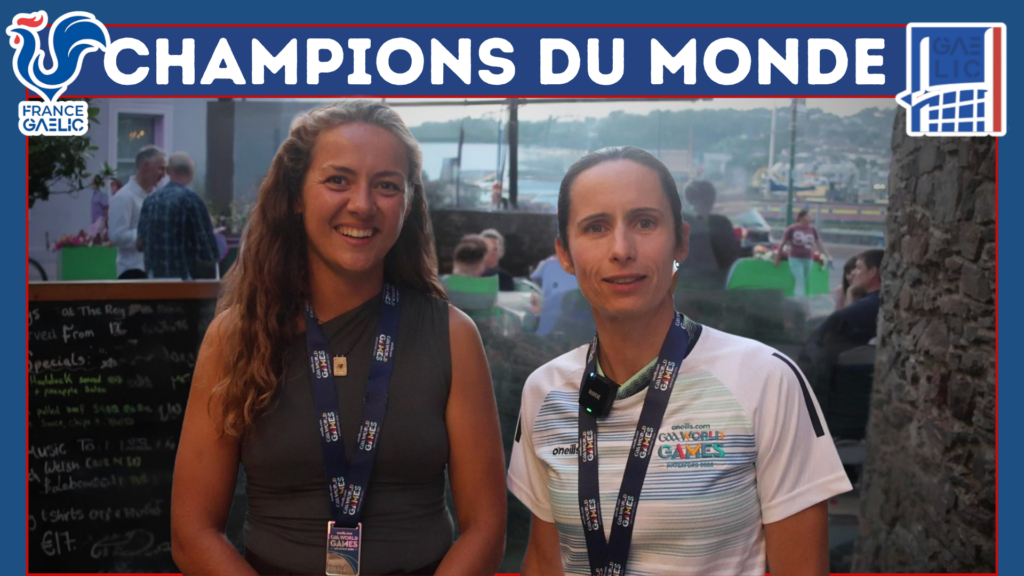
On 17 July 2026, France made Gaelic games history in Waterford, defeating San Francisco’s Fog City Harps by 6-5 to 0-7 to claim the International LGFA Division 1 title at the GAA World Games. It was a landmark achievement for continental Europe, and the crowning moment of more than two decades of work on French soil.
Leading the charge were captain Fanny Lezin and coaches Claire Bonnal and Estelle Roche, whose achievement was shared by an entire generation of players, volunteers and supporters.
Today, France boasts 36 Gaelic games clubs and more than 1,500 registered members. From just 160 players in 2008, the federation has seen its membership increase almost tenfold, a remarkable testament to nearly two decades of sustained grassroots development.
Few have witnessed this transformation more closely than Olivier Kowarski. With over twenty years of involvement in French Gaelic football, Olivier has seen the sport grow from a relatively unknown pastime into a thriving national sporting community. A French men’s national team coach and now a coach educator, he has played his own part in shaping that development. Speaking at the World Games in Waterford, Olivier reflected on two decades of progress, and the extraordinary journey of Gaelic football in France.
Of course, the growth of Gaelic football in France has required more than players and coaches. Behind the hundreds of fixtures taking place throughout the year is another indispensable group of volunteers: referees.
Among them is Fabien Régnier, founder of Lorient GAC, who first picked up a whistle fifteen years ago simply to help facilitate games. Today, he is helping to train a new generation of referees in France, ensuring that the expanding calendar of fixtures has the officials needed to sustain it.
At this year’s World Games in Waterford, Fabien had a personal milestone of his own to celebrate, adding another chapter to a remarkable journey alongside the French ladies’ historic triumph.
Behind this remarkable growth is an increasingly sophisticated organisational structure, coordinating clubs, competitions and development programmes across a country more than six times the size of Ireland.
At the heart of those efforts are Nathan Begoc and Stephen Hegarty, Chairperson and Secretary of the French Gaelic Games Federation. Speaking at the World Games in Waterford, the pair reflected on the extraordinary progress of Gaelic football in France, the challenges of sustaining a rapidly growing sporting community, and their ambitions for the years ahead.
Perhaps the greatest testament to the success of French Gaelic football lies not in the trophies won or the number of clubs established, but in the generation now coming through its ranks.
For young French players, particularly in Brittany, Gaelic football is no longer an unfamiliar Irish import, but a sport they have grown up playing. Years of investment in youth development are now bearing fruit, with players emerging from the French player pathway to compete at senior level and represent their country on the international stage.
Among them are Gaspard and Hugo, two young footballers who progressed through the French player pathway before making their senior international debuts at this year’s World Games in Waterford. Speaking at the tournament, they reflected on their experiences growing up with Gaelic football and the pride of representing France on the world stage.
Nowhere in France has Gaelic football found more fertile ground than Brittany, where the region’s Celtic ties with Ireland have helped the game take root.
It began in Rennes in 1998, when the first club in Brittany took the name Ar Gwazi Gouez, Breton for “The Wild Geese”, after the Irish soldiers who once served in France. When a Wicklow woman named Anna Marie O’Rourke joined the club in 2003, there were two clubs in the whole of Brittany. Today there are fourteen, with a Breton league running since 2008, and Rennes’ women have been crowned champions of France seven times.
Much of that growth came through the schools. Gaelic football is on the Breton curriculum, counts towards the baccalaureate, and since 2021 has been coached in primary schools across the region. Brittany now fields its own team in international competition, and in Waterford it lined out under its own banner alongside the French sides.
At the World Games we caught up with three of Brittany’s footballers, two of them twin sisters, on what drew them to the game, what it means in the region, and the pride of wearing Breton colours on a world stage.
Brittany fields its own teams at the World Games, under the French federation, and on the touchline the language is Breton.
Kadvael Jolivet found the game two years ago at Bro Leon in Brest – a footballer first, drawn in, as he puts it, by “the cultural side of the sport, and what it brings to our country.” This summer he played for Brittany’s second team, which went as far as the semi-final. Here, in Breton, he explains the pull between Brittany and Ireland: a Celtic tradition, music, a people who live with the sea — and why he is proud to wear Brittany’s colours.
The GAA has never been just about sport, and in Brittany, Gaelic football is no different.
Just days after our interview, Kadvael was preparing to take to the stage at the Vieilles Charrues festival in Carhaix, his voice hoarse from a week of shouting on the pitch, to rap in his native Breton. “Breton, like Irish, is a small language,” he explained, “and it’s important to put them on big stages.”
Instagram: https://www.instagram.com/plouzhafoen/?hl=en
There is something wonderfully fitting about that sentiment. Languages survive by being spoken, sung and passed down through generations. Sporting traditions are no different.
For more than twenty years, coaches, referees, administrators and volunteers have been doing precisely that across France, introducing Gaelic football to new communities, nurturing young players and building something that will endure long after the final whistle.
The world title won in Waterford was not simply the triumph of one team. It was the culmination of thousands of hours of largely unseen dedication, and a testament to what a determined community can achieve.
From a football pitch in Waterford to a festival stage in Carhaix, and the clubhouses of Brittany to the playing fields of Lyon, the same spirit lives on.
The trophy was won in Waterford. The victory was built in France.
And this Saturday, as 41 clubs from 12 countries gather in Lyon for the Kingspan Pan-European Championships, the next chapter begins.
Follow Gaelic Games Europe on Instagram and Facebook for coverage throughout the day.