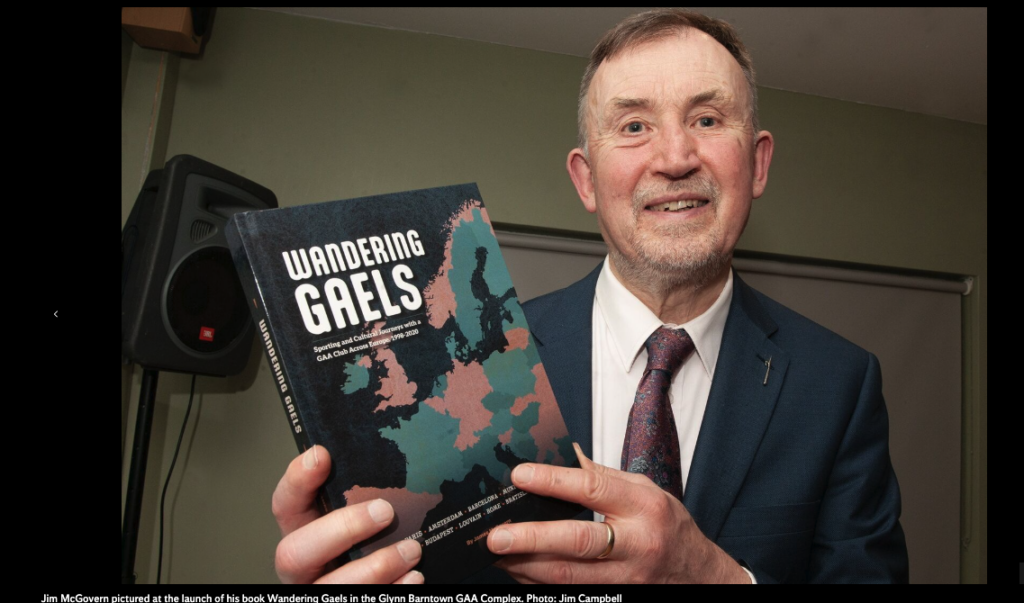
Jim McGovern’s Wandering Gaels is a book about journeys – across borders, across generations, and across the evolving map of Gaelic Games in Europe.
For decades, that community has been growing steadily: formalising its structures, maturing in ambition, expanding its reach, and now consolidating into a serious force, even winning competitive championships in Ireland.
If the question of sustainability was ever in doubt, it has been firmly answered over the past few years. The proof lies not only in the 110+ clubs playing week in and week out across the continent, but in the 34 clubs now offering youth programmes. These juvenlie structures are proof that Gaelic Games in Europe are no longer dependent solely on the next wave of Irish arrivals. They are being passed on, taught in schools, inherited, and claimed by a new generation.
On the main stage, Amsterdam changed the game by achieving glory in the Leinster Special Junior Hurling Championship for the first time, while Barcelona Gaels also broke records in the Leinster Football chamionship. It was a landmark moment for the club, and the wider European family.
The World Games will offer another powerful reminder of that progress. European teams will make up the majority share of the representative sides. Geography helps, of course. The closeness to Ireland is indeed a sixteenth man in this case. But that should not obscure the deeper story. Some of Europe’s strongest teams have little or no direct connection to Ireland, and that is precisely what makes them so important. The Galician and French national teams, in both GAA and LGFA, are not curiosities. They are serious competitors with credible ambitions for senior World Games glory. Their strength comes from something different: local ownership, cultural pride, and a version of Gaelic Games that has been rooted in their own communities.
Commercially, too, Europe has turned a corner. New sponsors are being drawn to a vast, well-connected network that binds communities across 24 borders. Clubs and county boards across the continent now command large online audiences, while new cooperation with the GPA through the international player exchange points towards a busier and brighter future for Gaelic Games in Europe.

But those who make the deals today have those who laid the foundations to thank.
That is where Jim McGovern’s Wandering Gaels deserves its tribute. McGovern was witness to much of the magic that formed the bedrock beneath Gaelic Games Europe as it exists today. His book is not simply a record of Glynn-Barntown’s journeys across the continent between 1998 and 2020. It is a testament to the people, places, friendships, and moments that helped prepare the ground for everything that has followed.
The importance of Wandering Gaels lies in the fact that it honours the individuals who marked the first pitches, hung the first nets, welcomed the first travelling teams, and imagined that Gaelic Games might have a future beyond the familiar boundaries of Ireland. McGovern does more than document matches and tours. He reveals the deeper Irish history present in some of Europe’s most active GAA stronghold cities, drawing a line between older Irish travellers, exiles, missionaries, soldiers, scholars, and the modern Gaelic strongholds that now exist across the continent.
In doing so, he gives us something valuable: a bridge between eras. Today’s European GAA is structured, ambitious, multilingual, digital, commercially aware, and increasingly youth-driven. But it did not appear from nowhere. It was built by volunteers, travellers, hosts, organisers, players, families, scholars, clergy, and friends who believed that a game could carry culture with it.
That is why the revelations in Wandering Gaels matter beyond the story of one club. They add depth to the European GAA story. They give it history, texture, and prestige. They remind us that Gaelic Games in Europe are not a temporary expression of Irishness abroad, but part of a much older pattern of movement, settlement, exchange, and cultural resilience.
In that sense, McGovern’s book strengthens the story Europe can tell about itself. It shows that today’s growth is not detached from the past. It stands on it. The new sponsors, youth structures, international teams, digital audiences, and competitive breakthroughs are all part of a longer journey – one shaped by the people who carried Gaelic Games with them before there was any guarantee that Europe would become fertile ground.
Wandering Gaels preserves that story before it disappears into memory. And at a time when Gaelic Games in Europe are stepping into a new level of confidence, Jim McGovern’s book reminds us that every bright future has a beginning worth honoring.
Gaelic Games Europe would like to thank Jim for the outstanding book, for immortalising the stories of our volunteers, and for adding his own chapter to the story of European GAA.
Go raibh maith agat Jim!
Buy the book here. Buy the book