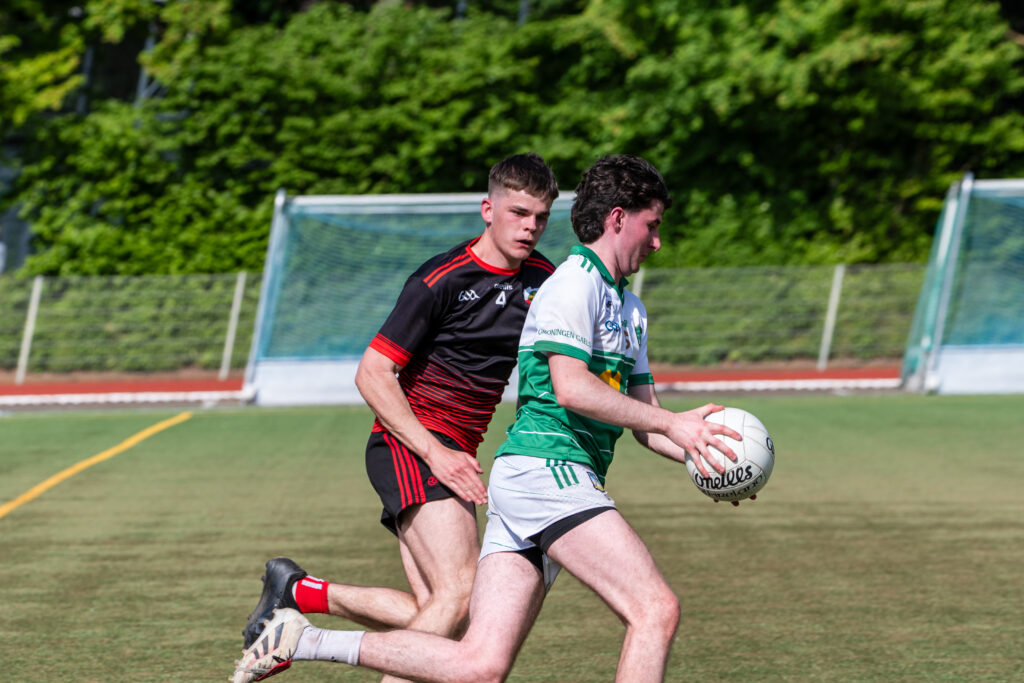
The Collegiate Games recently returned to Leuven for its fourth edition, bringing Europe’s student community back to the city where the tournament first began in 2022.
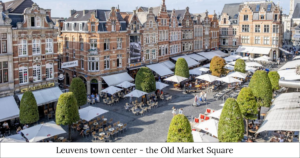
The Belgian town is a fitting host city for the Collegiate Games: compact, historic, and unmistakably student-driven. In municipal terms, Leuven is nearly the exact copy in physical scale to Galway City, with both covering just over 57 km², though Leuven’s population is slightly larger at just over 100,000. Inside Leuven’s ring, however, the historic centre is far more compact, giving the city a close-knit feel while still carrying the energy of a major university town. KU Leuven had 66,309 students in the 2024–25 academic year, including 16,020 international students, making Leuven a natural home for a tournament built around diverse student communities, cross-border friendships and Gaelic Games on the continent.
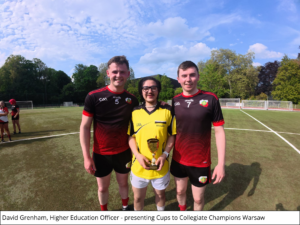
This year carried added significance as the first formally structured edition, held under the tenure of Gaelic Games Europe’s first-ever Higher Education Officer, David Grenham.
Grenham was present at the inaugural Collegiate Games in Leuven in 2022 and has now taken on the new role of helping to shape and support the Higher Education pathway across the continent. He is also chairperson of Groningen Gaels, one of the 10 Higher Education clubs currently active in Europe – a category defined by a club’s ability to field a full team of only active students.
For Gaelic Games Europe, the development of Higher Education is uniquely challenging. Unlike in Ireland, Britain or North America, there is no ready-made centralised university sports league structure across mainland Europe for Gaelic Games to slot into. Instead, the Higher Education pathway is being built from the ground up by student players.
That work is not without its obstacles. Clubs are spread across vast distances, travel costs are high, student budgets are often limited, and the academic calendar brings its own pressures, from exam periods to Erasmus exchanges, internships and changing student populations. Against that backdrop, the continued growth of the Collegiate Games is a significant achievement.
For Grenham, the challenge is worthwhile-
“The number of student players in Europe is growing. We’re seeing new clubs popping up every year. Most of these students are newly arrived from Ireland and may only be in Europe for one semester, so it is important to have at least one tournament where everyone can come together for a relaxed bit of football. Different to what they might be used to at home in Ireland.
The number of international student players is really impressive too. They seem to be learning a lot from the experienced Irish players, and hopefully they’ll bring the sports back with them and continue playing when they finish their studies”
Europe’s Higher Education clubs now stretch across several regions, with strong representation in the Benelux and Central-East regions in particular. The current network includes:
- Earls of Leuven, Belgium
- Groningen Gaels, the Netherlands
- Maastricht Gaels, the Netherlands
- Nijmegen GFC, the Netherlands
- Budapest Gaels, Hungary
- Bydgoszcz Gaels, Poland
- Cumann Warszawa, Poland
- Olsztyn Gaels, Poland
- Éire Óg Wroclaw, Poland
- Aarhus GAA, Denmark.
For information on studying abroad in English, students can contact any of the clubs directly.
There are rumblings of higher-education projects in Dresden, Germany; at least three institutions in Galicia; and many growing across France.
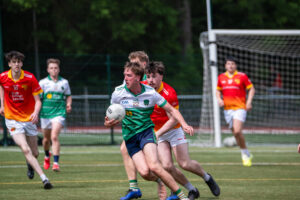
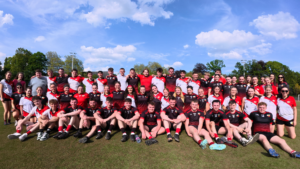
The 2026 tournament included 16 teams from just three clubs: Leuven, Groningen, and Warsaw.
Founded in 2018, Groningen Gaels have quickly become one of the benchmark student sides in Europe, regularly competing at the top end of tournaments and adding real quality wherever they travel. The city itself helps explain that energy. Groningen is one of the Netherlands’ great student cities, with more than 50,000 students making up around a quarter of the population, and a reputation for being young, international, bike-friendly and lively. Hanze University of Applied Sciences is also well known for applied and healthcare education, including physiotherapy, which has helped give the club a strong student base.
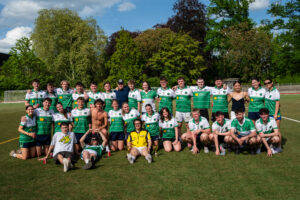
Warsaw’s contribution was deserving of both cups they claimed. A travelling contingent of 66 students arrived from Poland, bringing a level of class not often seen outside Ireland. Cumann Warszawa have built a remarkable reputation for sweeping the boards at the tournaments they attend, and in Leuven, they added another notch to that belt, dominating in both GAA and LGFA sides.
For many years, Higher Education Gaelic Games in Europe sat slightly outside the main development focus, for understandable reasons. Student clubs are often energetic, self-sustaining and capable of organising themselves, but they are also naturally transient, shaped by study cycles, Erasmus moves, graduations and the constant turnover of university life, often involving a major exodus of players at semester’s end. That makes long-term structures difficult to build.
Yet the landscape is beginning to change. Across Europe, Gaelic Games is now approaching its first generation of youth player pathway graduates — kids who have grown up with the games on the continent and are beginning to move into university life. Their arrival has the potential to transform Higher Education GAA from a short-term student experience into a lasting development pathway, carrying young players from underage clubs into adult Gaelic Games and helping bridge one of the biggest dropout points in the player journey.
Exciting times lie ahead for Higher Education GAA on the continent.
If you have any questions, please contact David @ highereducationofficer.europe@gaa.ie
Thanks to photographer @evan.dokter for the great content from the day!