The curtain is about to rise on the 2026 competitive season in the Benelux, and it’s business as usual more than usual!
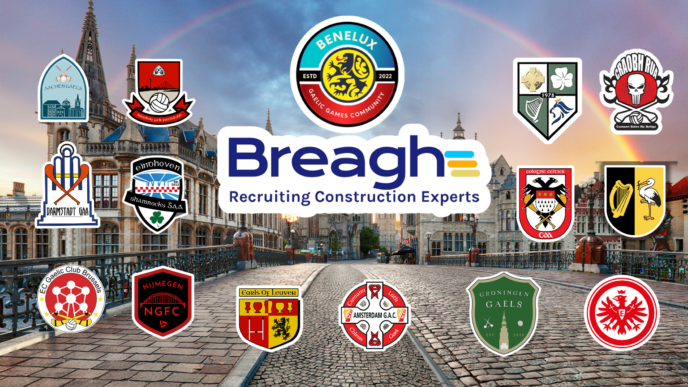
The Benelux division of Gaelic Games Europe has secured its first-ever major title sponsorship agreement, welcoming Breagh Recruitment as Official Regional Sponsor and Title Partner of the Benelux Competitions for the 2026–2027 term – the first agreement of its kind in the division’s history.
This partnership reflects the scale the region has now reached. Structured competitions, expanding youth programmes, provincial silverware and sustained participation have created an environment where long-term commercial alignment is not only possible, but appropriate.
Breagh Recruitment’s support will underpin the delivery and presentation of Benelux competitions across the next two seasons, strengthening the platform upon which clubs, players and volunteers continue to build.
Across the region, Gaelic Games are returning and flourishing:
Today in the Benelux:
Den Haag CLG prepares to host the 18th edition of the oldest running and most iconic Gaelic Football invitational tournament in mainland Europe, taking place this Saturday, 28 February. A competition steeped in tradition, it remains a cornerstone of the European calendar.
Maastricht Gaels are finalising preparations for the largest Féile Peile na nÓg ever staged on European soil – building on last year’s also record-breaking Féile in Amsterdam. At least 15 teams will take part, and for the first time ever, Europe will host an official competitive LGFA Féile, a landmark moment in the growth of the women’s game on the continent.
On the same date as the Féile, across the Netherlands in Eindhoven, all of Europe’s small ball enthusiasts go head to head in the first round of Hurling and Camogie of 2026. Hanging over the competition is the Leinster Special Junior Cup – claimed by Amsterdam GAC on 22 November last year, a breakthrough regarded as the most significant provincial success ever achieved by a European club.

The story of Gaelic Games in mainland Europe began in the Benelux – and it pre-dates the formal establishment of the European County Board. Organised GAA activity was already taking place in The Hague and Luxembourg before the official County Board structure was ratified in 1999. Indeed, two of the pioneering clubs at the very heart of European development were based in the Benelux, Den Haag CLG and Luxembourg GAA – laying the foundations for what would become today’s Gaelic Games Europe
When representatives gathered in Amsterdam in November 1999 to formally establish the European County Board, they were building upon groundwork already laid in this region. From those early diaspora-driven tournaments, the organisation has evolved into a structured, multi-regional unit spanning more than 20 countries. Today, the Benelux alone supports over 1,200 registered members across 16 clubs, delivering football, hurling, camogie, ladies football and youth competitions at an unprecedented scale. What began as small gatherings of committed volunteers has grown into one of the most vibrant international units in the global GAA family – and it started here in the Benelux.
Digital Evolution – New Benelux Website & Social Channels
Alongside developments on the field, the Benelux division is also launching its new dedicated website, a central hub for fixtures, results, club information and regional news. The platform reflects the professionalism and visibility the division has now achieved and will serve as the primary communication channel for the region moving forward.
Supporters, players and clubs are encouraged to follow the official Benelux social media channels for live updates, competition coverage and regional announcements as the 2026 season unfolds.
Click here for websiteFollow linkedin here: Benelux Linkedin
Instagram: Benelux GAA
Facebook: Benelux Facebook
From its earliest informal tournaments to a fully structured regional programme backed by its first title partner, the Benelux continues to set the standard for Gaelic Games development in mainland Europe.
2026 is not the beginning of something – it is the continuation of something built carefully over decades.
And now, it moves forward with Breagh Recruitment at its side.