When Gaelic Games Europe awarded hosting rights for one of it’s flagship event to Vannes, a club nestled in a rugby stronghold in the heart of Brittany, it was always going to be something special. But few could have predicted just how impactful the 2025 Kingspan Euro Gaelic Games would become – not just for the players, but for the future of the GAA in Europe.
Much of that success is thanks to the efforts of Gwened Vannes Football Gaélique, a club founded in 2009. Today, they field adult teams across all grades and run a thriving youth programme with 35 children aged 5 to 15. Their commitment to inclusion, development, and community spirit made them the perfect hosts for an event of this scale, and they delivered.
Over two days, Europe’s most talented regional players gathered to compete not as clubs, but as elite representative squads (teams you might consider to be Europe’s ‘County teams’), the very best from each territory, selected to prepare for the World Games in 2026. Kingspan’s arrival as title sponsor elevated the tournament into something more than a trial run: it became a declaration of ambition.
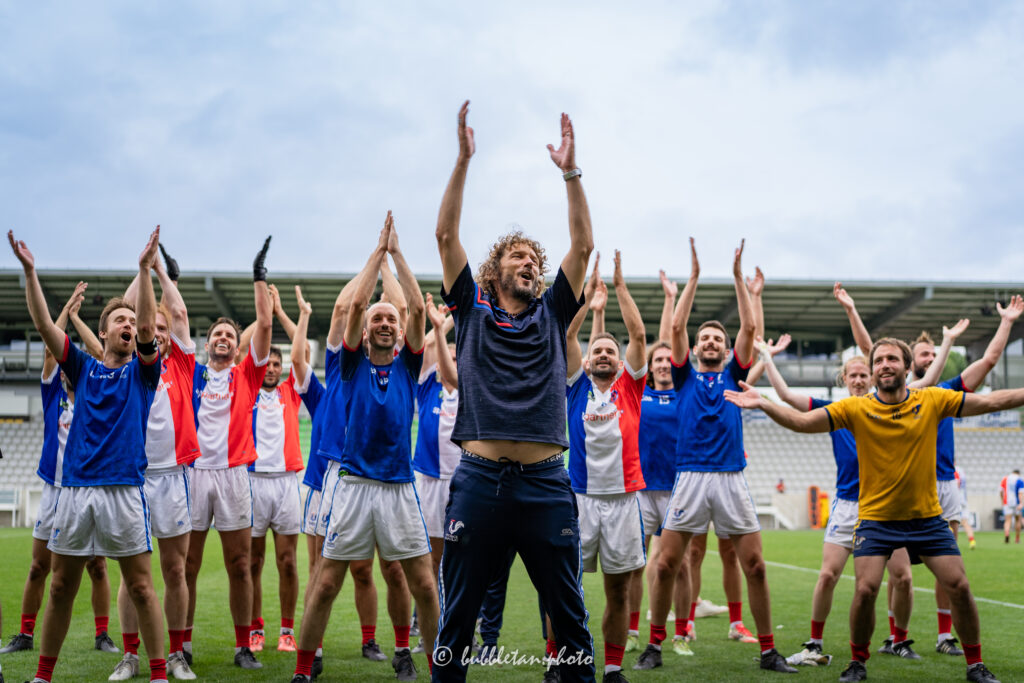
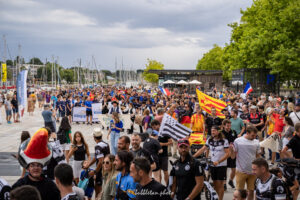
The French GAA community rose to the occasion, with Vannes GAA, local organisers, and volunteers executing the event with a level of professionalism and hospitality that drew praise from across the continent. After a thrilling Friday of pool matches, the tournament paused for a city-centre parade. A bold, joyful display of regional pride that brought Gaelic Games into the heart of everyday French life.
Saturday’s youth final was the moment that truly shifted the narrative. In the first-ever underage division of the Euro Games, France Gorm defeated Germany by a single point, capping a year in which thousands of schoolchildren across the continent were introduced to the sport through the work of development officers, led by Pearse Bell, based in Vannes. These are not symbolic gestures – they are part of a long-term strategy to embed Gaelic Games in European sporting culture.

The adult finals, meanwhile, offered drama and dominance in equal measure.
Men’s Division 1: France Champions 13 – France Challenger 9
Men’s Division 2: Brittany B 13 – Neustrie 3
Ladies Football Final: France A 22 – France B 6
Italy claimed third place in both senior competitions – a further reminder of how far the standard has risen continent-wide.
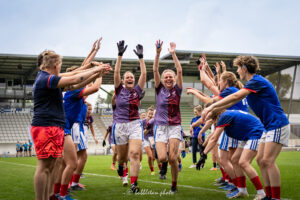
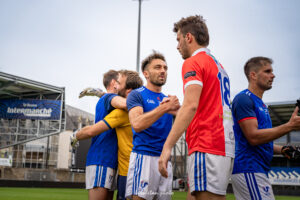
All finals were held at Stade de la Rabine, a professional rugby stadium welcoming Gaelic football for the very first time. Nearly 2,500 paying supporters filled the stands. Not just spectators, but genuine fans who had travelled to be part of something special. Their presence marked a milestone: the strongest live attendance for a GAA event in continental Europe to date.
And they weren’t alone. More than 3,500 viewers tuned in online for Friday’s group stages on YouTube, while the finals broadcast on SPORTALL drew in another 2,400 views, bringing the atmosphere in Vannes to screens across France and beyond.
Mark Brannigan, long-time Vannes GAA volunteer, national team coach, and tournament organiser, played a central role in the success of the event. A Dub who learned his trade on Mobhi Road with Na Fianna CLG, he moved to France in 2011 and quickly got involved with Paris Gaels.
“I was immediately struck by the differences from home,” he said. “Ninety percent of the players were French. There was an openness, a desire to learn and experience the games — very different from trying to break through at adult levels in Dublin.”
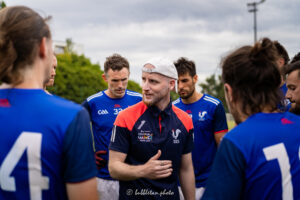
Brannigan began coaching Paris Gaels in 2012 and joined the French national coaching setup in 2017. This year, he also stepped into a groundbreaking new role: providing live French-language commentary for the All-Ireland semi-final – and he’ll return to the mic for the upcoming final, joined by Frenchman and GAA referee Fabien Regnier (Lorient GAA), and Kevin Dowling from Nantes GAA. The matches, streamed by SPORTALL, reached over 6,000 viewers in France.
“It was both a bizarre and amazing experience,” he said. “It was a brilliant opportunity to broaden awareness of our game. Getting the balance right between explaining the rules, giving context, and helping a new audience understand why someone like Michael Murphy matters — that was a fun challenge.”
Looking ahead, Brannigan has a clear vision for the game in France:
“There are four things I’d love to see:
- That we continue to increase visibility and awareness of the sport throughout the country; through these initiatives, we have a great opportunity. Given the athletes, talent, and overall spectacle on show, Gaelic football has the potential to be a globally recognised sport.
- Increase participation and the number of GAA Clubs as much as possible; the growth and creation of new clubs is already at a rapid pace. Work is going on for gaelic games to be recognised by the French state, which would massively improve our ability to access funding and support.
- Continue to improve the level and standard at which we play. Build on the development of youth teams, the first u18 national selection, to create teams that can compete with London, Warwickshire, New York on the international stage.
- The development of more 15-a-side pitches. There is only one in France, in Rennes, two in Europe. Our ability to compete with the teams mentioned above, and Irish teams, is dependent on our ability to play 15 a side football on a regular basis.
With 32 clubs now active across France, and around 95% of players French-born, Gaelic Games in France is not a new phenomenon. It’s the result of over a decade of local leadership, steady growth, deep community roots, and a successful player pathway. Today, France isn’t just hosting European GAA, it’s setting the pace.
Follow France GAA here and see the list of clubs